Bertha Wilhelmine Schmidlin (1848–1913) A life marked by grace, resilience, and reinvention
cc:https://www.abebooks.co.uk/paper-collectibles/Ansichtskarte-Postkarte-Altmannshofen-Aichstetten-Allg%C3%A4u-W%C3%BCrttemberg/32171316456/bd
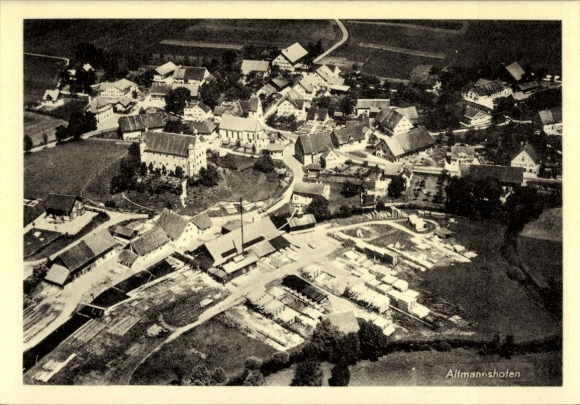
Bertha was the first child of Eduard Schmidlin’s second marriage, born on 18 September 1848 at Castle Altmannshofen near Leutkirch in the Allgäu region of Württemberg. Her birth registry lists her simply as Bertha, though later records refer to her as Bertha Wilhelmine. On 9 October 1865, at just 17 years old, Bertha married Otto Stephani, an engineer from Mannheim nearly twice her age. The wedding took place in Brienz, and by all accounts—including those of her father—it was a love match. Otto had been appointed the first director of Bern’s municipal gasworks in 1861, following in the footsteps of his elder brother Ludwig, who held a similar post in Budapest. The couple lived in a residence built specifically for the gasworks director, a house still standing today in the Marzili quarter of Bern by the River Aare. Tragically, Otto Stephani died just four months after their marriage, following a prolonged illness.
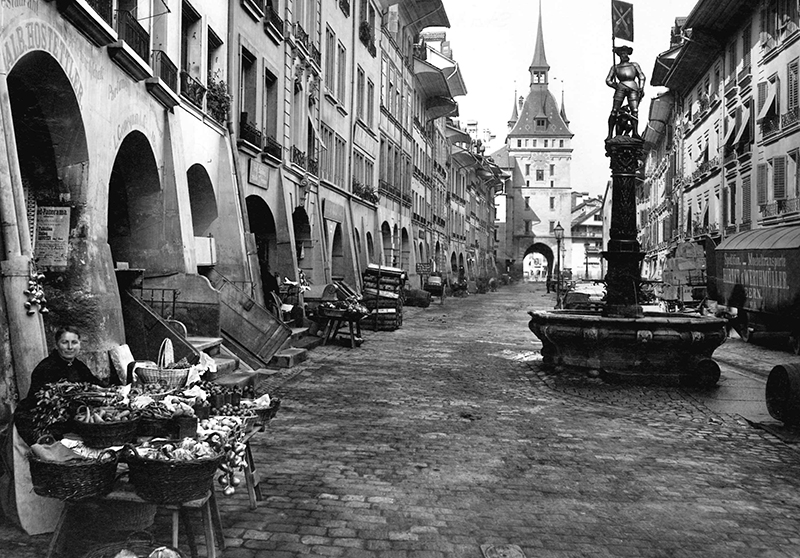
Photo: Bern city archives CC: https://blog.nationalmuseum.ch/en/2018/04/the-time-the-bernese-put-their-foot-on-the-gas/
Widowed at 18, Bertha returned to Giessbach to assist her parents in managing the family hotel. She and her sister Marie quickly became beloved figures among guests for their charm, warmth, and impeccable manners. Bertha’s presence at the Giessbach Hotel was so notable that she appeared, under her real name, as a character in Der Löwe von Luzern (The Lion of Lucerne), a four-volume novel published in 1867 by Philipp Galen. The author referred to her as the “Hebe of the Giessbach,” praising her dignity and grace, noting that her conduct set an example for her younger sister and left a lasting impression on all visitors. Both sisters reportedly spoke fluent English and French in addition to their native German—remarkable, given the era’s limited educational opportunities for women in such a remote location. It is presumed they were privately educated. It was likely at Giessbach that Bertha met John Bullough, though the exact circumstances of their meeting remain unknown.

CC:https://museum-holzbildhauerei.ch/en/grand-hotel-giessbach-where-style-meets-art/
They were married in Brienz on 11 February 1869. By then, Bertha had become a naturalised Swiss citizen, along with the rest of the Schmidlin family, in April 1868. She moved to Lancashire with her husband, where her two eldest children—George (1870) and Bertha (1872)—were born. By 1880, Bertha and John Bullough were separated and in the process of divorcing. She was then living at the Bellevue Hotel in Thun with her parents, where her third child, Edward, was born on 28 March 1880. When her parents retired from the Bellevue in late 1882, they moved to Dresden to live with their youngest daughter, Johanna. The first Schmidlin entries appear in the Dresden telephone directory in 1884, listing Eduard, Johanna, and Bertha Wilhelmine Bullough at separate addresses. It remains unclear who initiated the move to Dresden or whether the family had any prior connections to the city.
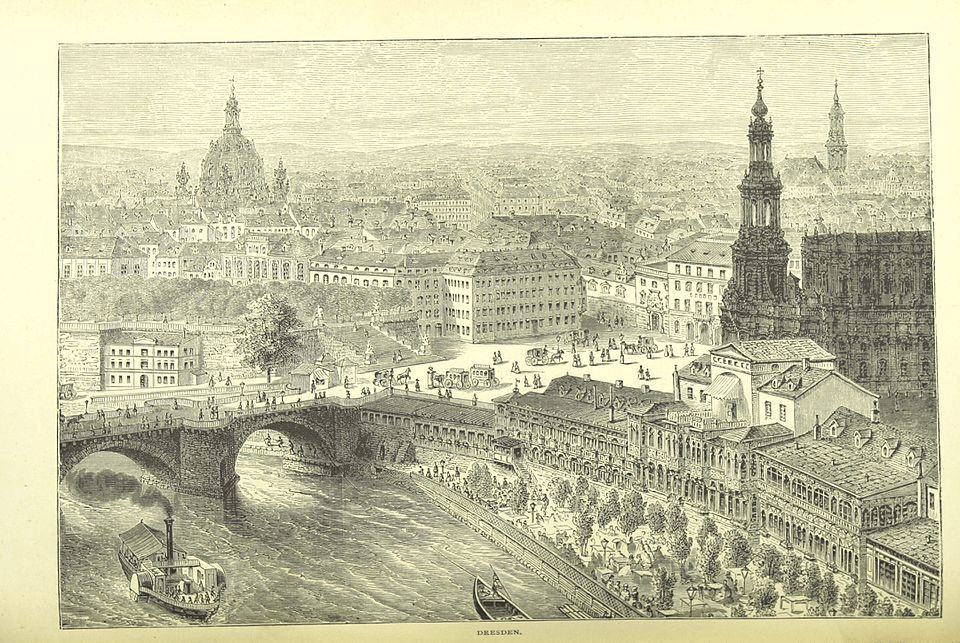
Image extracted from page 56 of Pictures from the German Fatherland, drawn with pen and pencil’, by GREEN, Samuel Gosnell. Original held and digitised by the British Library. Copied from Flickr under CC.
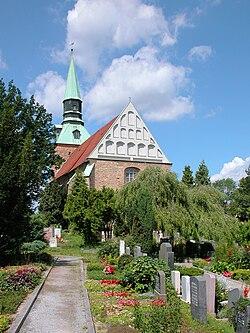
On 9 January 1886, Bertha married for the third time—this time to Judge Friedrich Eduard Strüver, ten years her junior. Together, they had one son and three daughters. Bertha became a respected figure in Dresden society. According to one of her granddaughters, she was admired not only for her dignity but also for her progressive approach to family life—insisting, for instance, that her children take regular baths, an uncommon practice in German households at the time. Bertha Strüver died on 13 November 1913 in Dresden and was buried in the Protestant cemetery in Leubnitz-Neuostra, just outside the city. Her husband, who died in 1939, is interred in the same grave, along with other family members.
CC: https://commons.wikimedia.org/wiki/File:Kirche_Leubnitz-Neuostra_2010.JPG
Contributed by Thomas Krebs, edits by S. Walker.
 Kinloch Castle Friends Association
